
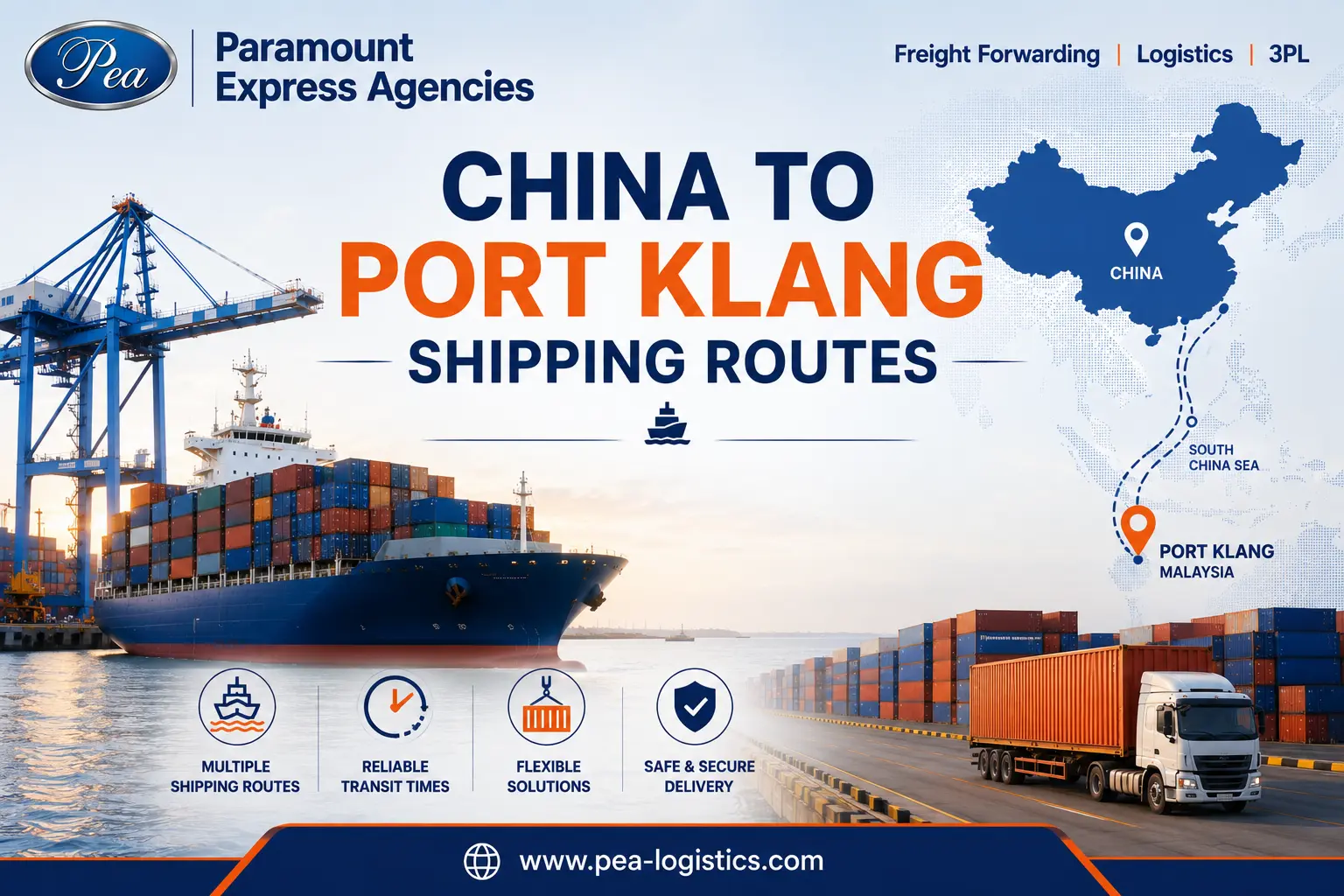
China to Port Klang is one of the busiest and most important sea freight corridors in Southeast Asia. China operates over 150 major ports, but a dozen or so handle the vast majority of container volume moving toward Malaysia. This guide covers every major China origin port with a direct or well-established route to Port Klang — realistic transit times, what each port is best suited for, and how to use the ASEAN-China Free Trade Agreement to your advantage.
Paramount Express Agencies has specialised in China-to-Port Klang freight since 1997. This route is one of our core strengths — here’s the complete port-by-port breakdown.
Table of Contents
- Why the China–Port Klang Route Matters
- China to Port Klang: Full Route-by-Route Guide
- Shanghai to Port Klang
- Ningbo-Zhoushan to Port Klang
- Shenzhen to Port Klang
- Guangzhou (Nansha) to Port Klang
- Qingdao to Port Klang
- Tianjin to Port Klang
- Xiamen to Port Klang
- Hong Kong to Port Klang
- Dalian to Port Klang
- Fuzhou to Port Klang
- Suzhou to Port Klang
- Beibu Gulf (Qinzhou/Fangchenggang) to Port Klang
- Transit Times at a Glance
- FCL vs LCL: Which Should You Choose?
- Shipping Costs and Rate Ranges
- Cutting Duty to Zero with ACFTA
- Customs Clearance at Port Klang
- Why Your Freight Forwarder Matters
- Frequently Asked Questions
- Sources
Why the China–Port Klang Route Matters
China is Malaysia’s largest trading partner, and Port Klang handles the majority of that sea freight volume. Most of China’s top container ports — spanning the Yangtze River Delta, the Pearl River Delta, and the northern Shandong/Bohai Rim region — connect to Port Klang either directly or via a short transshipment leg through Hong Kong or Singapore. This gives shippers real flexibility: the “best” origin port often depends less on overall port size and more on which Chinese region your supplier is based in.
For importers, this route density means fewer transshipment risks on most lanes, more predictable transit windows, and — thanks to the ASEAN-China Free Trade Agreement — a real opportunity to reduce landed cost through preferential duty rates.
China to Port Klang: Full Route-by-Route Guide
Below is every major China port with an established route to Port Klang, organised roughly north to south.
Shanghai to Port Klang
Shanghai is the world’s busiest container port and China’s flagship gateway, sitting at the mouth of the Yangtze River. Direct services to Port Klang typically take 7 to 10 days. Shanghai’s scale and route density make it a strong option for almost any cargo type, and it’s often the default choice for shippers sourcing from the wider Yangtze Delta manufacturing belt.
Ningbo-Zhoushan to Port Klang
Ningbo-Zhoushan is one of China’s largest ports by cargo tonnage and sits close to Shanghai, making it a popular alternative when Shanghai faces congestion. Transit to Port Klang runs similarly at 7 to 10 days. It’s well suited to mineral and bulk cargo alongside containers, and offers competitive inland transport costs for shippers based around Ningbo and Zhejiang province.
Shenzhen to Port Klang
Shenzhen — including its Yantian, Shekou, and Chiwan terminals — is southern China’s major export hub and one of the fastest routes to Port Klang, typically 5 to 7 days. Its proximity to the Pearl River Delta and Hong Kong gives it dense sailing schedules and flexible routing. This is generally the preferred origin port for electronics, appliances, and time-sensitive consumer goods.
Guangzhou (Nansha) to Port Klang
Guangzhou, China’s second-largest port by cargo turnover, serves the Pearl River Delta alongside Shenzhen. Its Nansha port area has expanded rapidly in recent years. Transit to Port Klang is comparable to Shenzhen, generally 5 to 7 days, and it’s often the more cost-competitive option for shippers on the western side of the Pearl River Delta (Guangzhou, Foshan, Zhongshan).
Qingdao to Port Klang
Qingdao is northern China’s leading foreign trade port, part of the 21st Century Maritime Silk Road network, with connections to 230+ international shipping routes — the most extensive network among northern Chinese ports. Being furthest from Malaysia among the major routes, transit typically runs 10 to 15 days. It’s the primary gateway for cargo sourced from Shandong province and the broader northern industrial belt.
Tianjin to Port Klang
Tianjin is the largest port in North China and Beijing’s maritime gateway, one of the world’s largest man-made ports. Along with Qingdao, it’s a non-negotiable routing choice for shippers needing access to northern China and the Bohai Rim region. Transit to Port Klang is broadly similar to Qingdao, in the 10 to 15 day range given the greater distance from Malaysia.
Xiamen to Port Klang
Xiamen, in Fujian province, plays an important role in trade with Taiwan and Southeast Asia and operates within a free trade zone. Routes to Port Klang run direct or via Hong Kong, typically 5 to 8 days. It’s a solid option for shippers sourcing from Fujian’s manufacturing base.
Hong Kong to Port Klang
Hong Kong functions both as a direct origin port and as a transshipment hub for cargo from other Chinese ports, particularly Xiamen and southern China generally. Its deep logistics infrastructure and international connectivity make it a useful alternative when direct sailings from a specific mainland port are limited. Typical transit to Port Klang runs 5 to 8 days.
Dalian to Port Klang
Dalian is a key northeastern China port, serving Liaoning province and the broader northeast industrial region. It’s a less direct route to Port Klang than the southern ports, generally requiring 12 to 16 days depending on transshipment routing. Best suited to shippers specifically sourcing from northeast China where Qingdao or Tianjin aren’t the closer option.
Fuzhou to Port Klang
Fuzhou, also in Fujian province, is a smaller but established port serving the region alongside Xiamen. Routes to Port Klang typically run via Xiamen or Hong Kong transshipment, adding some time over a direct sailing — generally 7 to 10 days total. A practical option for shippers based in Fujian outside the Xiamen catchment area.
Suzhou to Port Klang
Suzhou is a major river port within the Yangtze River system, effectively feeding into the Shanghai gateway for onward international shipping. Cargo from Suzhou typically moves via Shanghai, so total transit to Port Klang tracks closely with the Shanghai route, around 8 to 11 days once inland transfer is included.
Beibu Gulf (Qinzhou/Fangchenggang) to Port Klang
The Beibu Gulf port cluster in Guangxi province, including Qinzhou and Fangchenggang, is a strategically growing gateway specifically positioned to serve Southeast Asia. Given its location on China’s southern coast facing the South China Sea, it offers some of the more geographically direct routing to Malaysia, though sailing frequency is lower than the major Pearl River Delta ports. A good option for shippers newly sourcing from Guangxi or wanting an alternative to the busier southern ports.
Transit Times at a Glance
| Origin Port | Region | Typical Transit to Port Klang |
|---|---|---|
| Shenzhen | South China (Guangdong) | 5–7 days |
| Guangzhou (Nansha) | South China (Guangdong) | 5–7 days |
| Xiamen | Fujian | 5–8 days |
| Hong Kong | South China | 5–8 days |
| Fuzhou | Fujian | 7–10 days |
| Shanghai | East China | 7–10 days |
| Ningbo-Zhoushan | East China (Zhejiang) | 7–10 days |
| Suzhou (via Shanghai) | East China (Jiangsu) | 8–11 days |
| Beibu Gulf (Qinzhou/Fangchenggang) | South China (Guangxi) | 8–12 days |
| Qingdao | North China (Shandong) | 10–15 days |
| Tianjin | North China | 10–15 days |
| Dalian | Northeast China | 12–16 days |
These are port-to-port direct or near-direct transit estimates and can vary by carrier and season. LCL shipments typically add 7 to 10 days for consolidation and deconsolidation, and total door-to-door lead time — including origin pickup, documentation, and local delivery — usually runs an additional 4 to 8 days beyond the ocean transit window.
FCL vs LCL: Which Should You Choose?
The first decision on any China-to-Port Klang shipment is whether to book a full container (FCL) or share space with other cargo (LCL):
- FCL (Full Container Load): You book an entire 20-foot (~33 cbm) or 40-foot (~67 cbm) container. Best for larger volumes, fragile or high-value goods that shouldn’t be handled alongside other cargo, and shipments where speed matters — FCL skips the consolidation step.
- LCL (Less than Container Load): Your cargo shares a container with other shippers’ goods. Cost-effective for smaller volumes, but adds 7 to 10 days for consolidation and deconsolidation, and carries more handling risk.
As a general guide, the FCL-versus-LCL crossover point tends to sit around 15 cubic metres — below that, LCL is usually more economical; above it, FCL often becomes the better value per unit.
Shipping Costs and Rate Ranges
Ocean freight rates from China to Malaysia have stabilised through early-to-mid 2026 after the volatility of 2024–2025, though they remain above pre-pandemic levels and are subject to seasonal surges, particularly ahead of Chinese New Year and Q4 peak season. Indicative base ocean freight rates:
- 20ft container (FCL): approximately USD 800–1,400, depending on origin port and carrier
- 40ft container (FCL): approximately USD 1,400–2,400, depending on origin port and carrier
- LCL: typically priced per cubic metre, and has generally held more stable than FCL rates
These are base ocean freight figures only — they exclude destination charges, customs clearance fees, haulage, and any applicable duties or SST. Rates can also shift with bunker adjustment factors (BAF) and geopolitical developments affecting shipping lanes, so always confirm a fresh quote close to your booking date.
Cutting Duty to Zero with ACFTA
The ASEAN-China Free Trade Agreement (ACFTA) allows eligible goods of Chinese origin to enter Malaysia at a preferential — often zero — import duty rate. Duty reduction under ACFTA began in July 2005, with most product tariffs progressively eliminated or reduced since. Under the Sensitive List schedule, ASEAN-6 countries and China further reduced tariffs to 20% by 2012 and down to 0–5% by 2018 for products in that category.
To claim ACFTA preferential rates, your Chinese exporter needs to issue a Certificate of Origin Form D, obtained from China Customs or an authorised issuing body. A few important rules:
- Form D must be issued before or at the time of shipment departure — it cannot be backdated.
- Royal Malaysian Customs Department (RMCD) requires the original Form D at clearance.
- Goods must meet ACFTA Rules of Origin, generally requiring a set threshold of local (Chinese) content or qualifying production process.
- The duty difference can be substantial on products still subject to a Most Favoured Nation (MFN) rate versus the ACFTA preferential rate — this materially changes landed cost on large orders.
If your supplier can’t issue a valid Form D, it may signal that the goods don’t meet the Rules of Origin threshold — worth checking before you commit to a purchase order.
Customs Clearance at Port Klang
Most commercial imports through Port Klang are subject to Malaysia’s Sales and Service Tax (SST), commonly falling within a 5% to 10% range depending on product classification. Clean, accurate documentation — commercial invoice, packing list, correct HS codes, and the ACFTA Form D where applicable — is the single biggest factor in avoiding delays at customs.
Some product categories also require Sirim approval or other regulatory sign-off before release, so it’s worth checking product-specific requirements before your shipment departs China, not after it arrives.
Why Your Freight Forwarder Matters
China-to-Port Klang is a high-volume, high-frequency trade lane, but that doesn’t mean it’s simple. With more than a dozen viable origin ports across three distinct Chinese regions, choosing the right one, matching FCL or LCL to your volume, securing a valid ACFTA Form D, and having documentation ready before your container lands all directly affect your total cost and how fast your goods clear customs.
Paramount Express Agencies has coordinated China-to-Port Klang sea freight since 1997 — this route is one of our core specialities. We manage origin booking across any of China’s major ports, ACFTA documentation, customs clearance at Port Klang, and final-mile haulage as one coordinated service, so your cargo moves efficiently from wherever your supplier is based straight through to your door.
Frequently Asked Questions
How long does shipping from China to Port Klang take?
Direct ocean transit ranges from 5–7 days for South China ports like Shenzhen and Guangzhou, up to 12–16 days for northern ports like Dalian. Total door-to-door lead time, including origin pickup and local delivery, typically adds another 4–8 days.
Which Chinese port is fastest to Port Klang?
Shenzhen and Guangzhou (Nansha) in South China offer the fastest direct transit, typically 5 to 7 days, thanks to their proximity and high sailing frequency from major carriers.
Do I have to ship from one of the biggest Chinese ports?
No. The largest port isn’t always the best option — the right origin port usually depends on where your supplier’s factory is located, since inland trucking to a distant port can add more cost and time than choosing a closer, smaller port with slightly less frequent sailings.
Can I get zero duty on goods from China under ACFTA?
Many products qualify for 0% or reduced duty under the ASEAN-China Free Trade Agreement, provided your Chinese exporter issues a valid Certificate of Origin Form D and the goods meet the Rules of Origin threshold.
Should I choose FCL or LCL for China to Port Klang shipments?
FCL is generally more economical above roughly 15 cubic metres of cargo and avoids consolidation delays. LCL is better suited to smaller volumes but typically adds 7 to 10 days for consolidation and deconsolidation.
What documents do I need to clear customs at Port Klang?
At minimum, a commercial invoice, packing list, and correct HS codes. If claiming ACFTA preferential duty, you’ll also need the original Certificate of Origin Form D issued before shipment departure.
Shipping from China to Port Klang? This is one of Paramount Express Agencies’ core trade lanes. Talk to our team for a route-specific quote, ACFTA documentation support, and end-to-end coordination from any major Chinese port to your door in Malaysia.
Sources
- Malaysia International Trade and Industry (MITI) — ASEAN-China Free Trade Agreement (official tariff reduction schedule)
- DHL — China Import Duty and Tax Rates Guide (ACFTA duty exemption overview)
- iContainers — Top 10 Major Ports in China (2025 container throughput rankings by port)
- OUCO Industry — Top 10 Ports in China: Rankings, Features & FAQs (regional port classification, Qingdao route network)
- Freightos — Top Chinese Ports for Container Shipping (port infrastructure and history reference)


